What Factors Should I Consider When Choosing LED Downlights?
Aug 15, 2026
What is the fastest way to choose the right LED downlight?
To choose the right LED downlight, start with four questions: How much light do you need? How widely should the light spread? Can the fitting safely contact ceiling insulation? And what color of white light suits the space? In product specifications, these questions correspond mainly to lumens, beam angle, insulation-contact rating, and correlated color temperature (CCT).
Start by focusing on lumens rather than watts for brightness; consider a wider beam angle, often around 60° to 90°, for general rooms; a narrower angle, often around 25° to 45°, for task or accent areas; an appropriate IC-4 or equivalent rating when the fitting may touch insulation; and a CCT suited to the room. These are starting points, not substitutes for a lighting plan, local code, or the manufacturer’s instructions.
Should you compare lumens or watts?
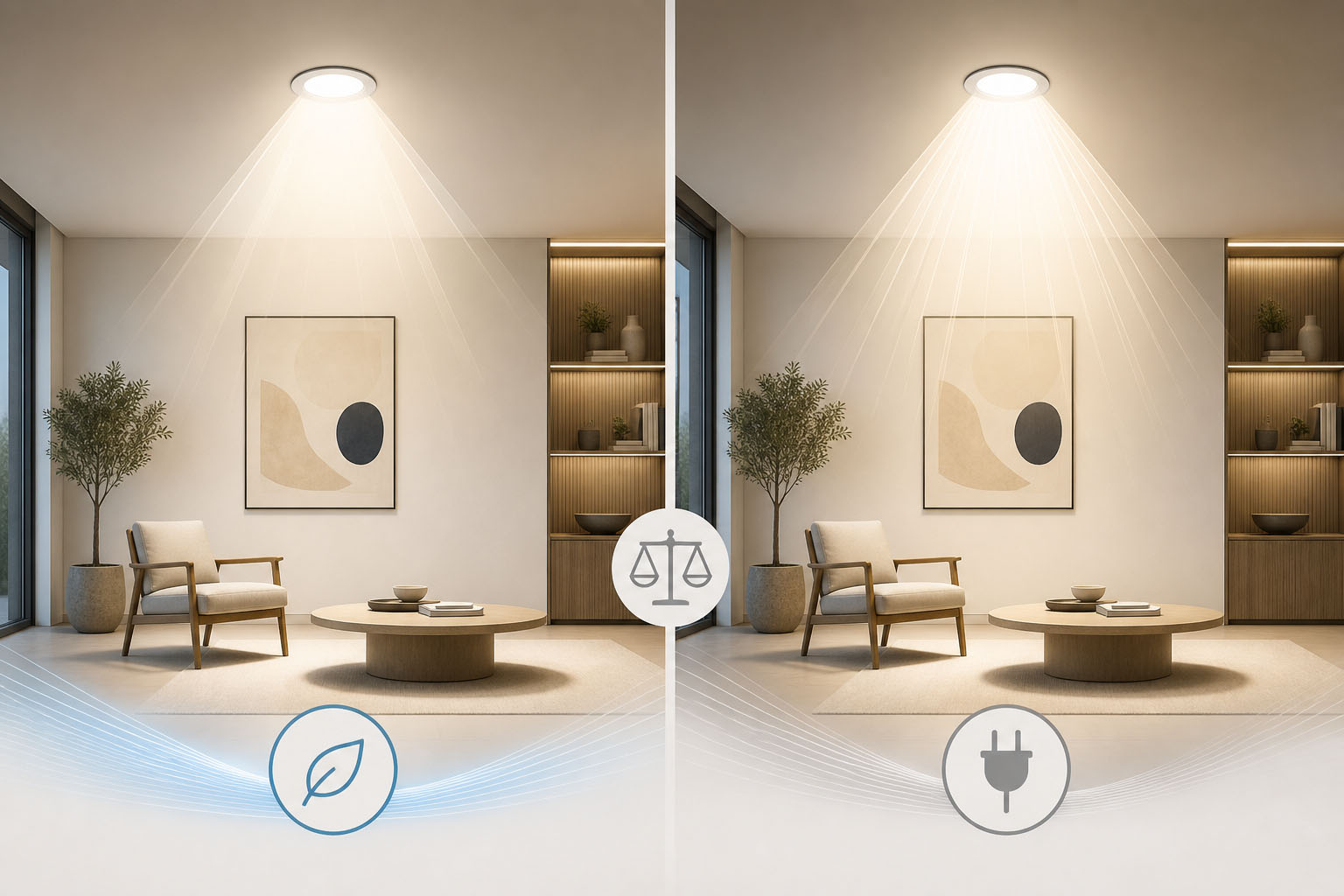
Compare lumens when you want to understand light output. Compare watts when you want to understand electrical input. Lumens describe the amount of visible light produced, while watts describe how much electrical power the product consumes. A more efficient LED can produce similar light output with fewer watts, so wattage alone is not a reliable brightness measure.
For a fair comparison, check the delivered lumens of the complete downlight or luminaire, not only the LED chip’s theoretical output. Also review the beam distribution, aperture size, mounting height, and whether the published value is initial or maintained output. A downlight with more lumens is not automatically better if it creates glare, hot spots, or excessive brightness for the room.
Figure 1. Lumens describe useful light output; watts describe electrical input. The illustration is conceptual, not a product performance test.
Energy efficiency is commonly expressed as lumens per watt (lm/W), calculated by dividing light output by input power. ENERGY STAR uses this type of performance measure in its downlight criteria. Treat lm/W as an efficiency metric—not as a replacement for total lumens or visual comfort.
How does beam angle affect a downlight?
Beam angle describes how broadly the light spreads from the fixture. A wider beam covers more area with softer transitions, while a narrower beam concentrates light on a smaller area and can create stronger emphasis.
As a practical starting point:
Application
Typical starting beam angle
What it does
Watch-outs
General living room, bedroom, corridor, or open area
60°–90°
Spreads light broadly for ambient illumination
Excessively wide spacing can still create dark patches
Kitchen counter, desk, vanity, or work surface
25°–45°
Concentrates light where a visual task takes place
Too narrow may create glare or harsh shadows
Artwork, display, feature wall, or retail accent
15°–40°
Directs attention toward a selected object or surface
Check aiming, glare, and shadowing
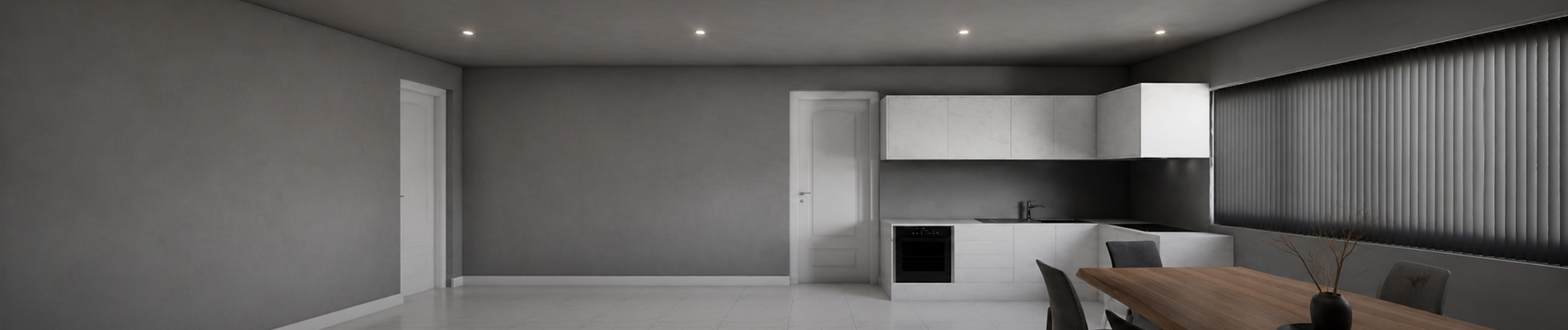
These ranges are starting points rather than fixed rules. Ceiling height, fixture spacing, lumen output, reflector design, wall color, and the desired illuminance all affect the final result. A useful design should consider the beam pattern—not only the angle printed on the box.
Figure 2. Beam angle changes how broadly a downlight distributes light. The three zones are conceptual examples, not a photometric diagram.
When do you need an IC-4 or equivalent insulation-contact rating?
If a recessed downlight is installed in a ceiling where insulation may touch or cover the fixture, verify that the product is approved for that installation condition. IC generally refers to insulation contact, but the exact designation—such as IC-4, IC-rated, or another regional marking—must be interpreted according to the applicable standard and certification.
Do not assume that every recessed LED is safe to cover with insulation. Check the product label, certification file, installation instructions, required clearance, and whether the product is also approved for the specific insulation type used on the project. ENERGY STAR’s downlight criteria state that Type IC products must be approved for zero-clearance insulation cover by an OSHA-recognized Nationally Recognized Testing Laboratory. UL Solutions also documents separate requirements for recessed luminaires intended to contact certain spray-foam insulation.
This is a safety and compliance issue, not merely a performance preference. When the ceiling assembly, insulation, or jurisdiction is uncertain, consult a qualified electrician or building professional before installation.
How should you choose the right CCT?
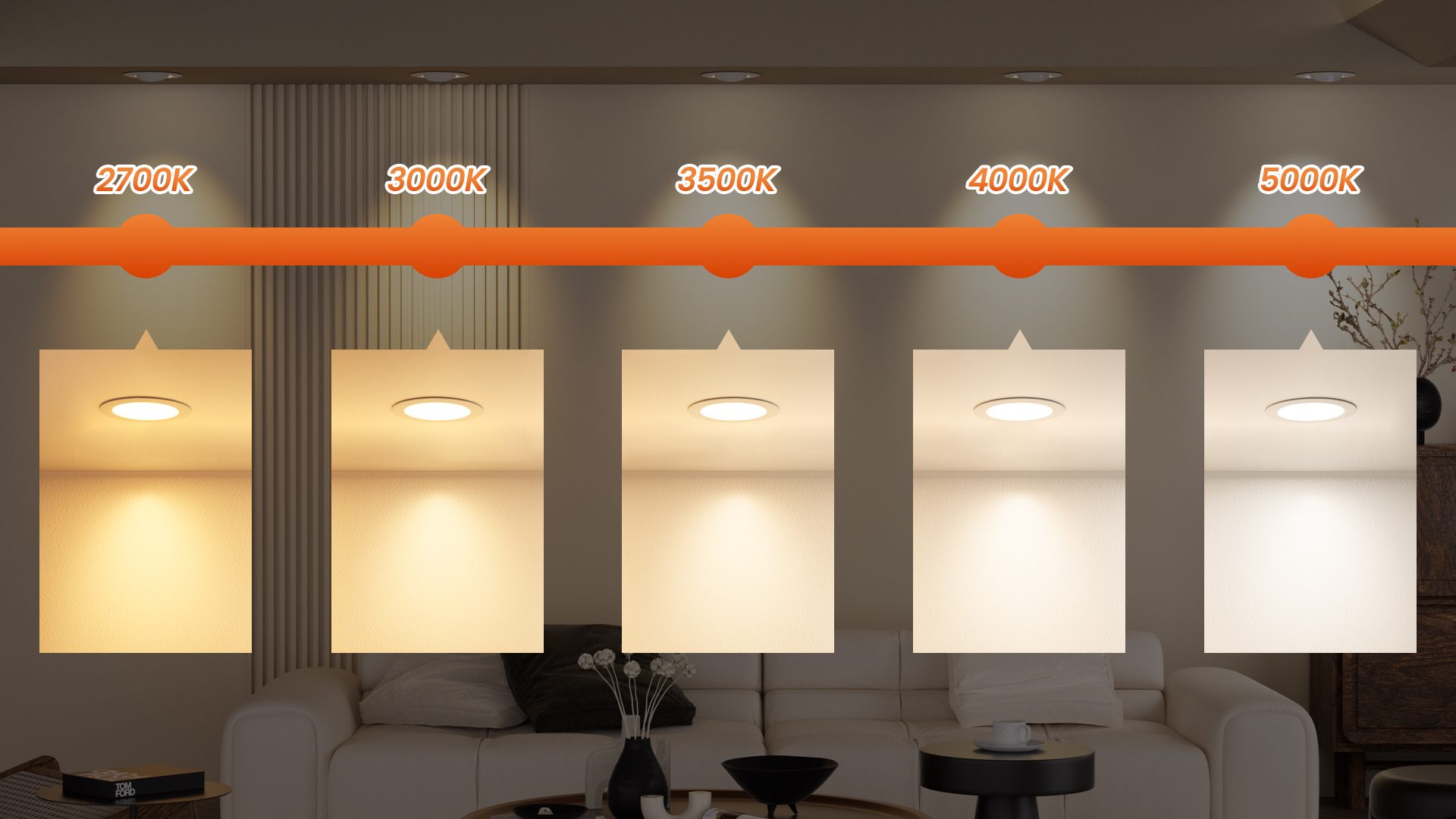
CCT, or correlated color temperature, describes whether white light appears warm or cool. Lower values usually look warmer and more yellow; higher values usually look cooler and bluer. Common starting points include:
CCT range
Visual character
Common applications
2700K–3000K
Warm, relaxed, residential
Bedrooms, living rooms, restaurants, hospitality
3500K
Balanced or neutral
Kitchens, offices, retail, multipurpose spaces
4000K and above
Cooler, more alert
Work areas, garages, utility rooms, some commercial settings
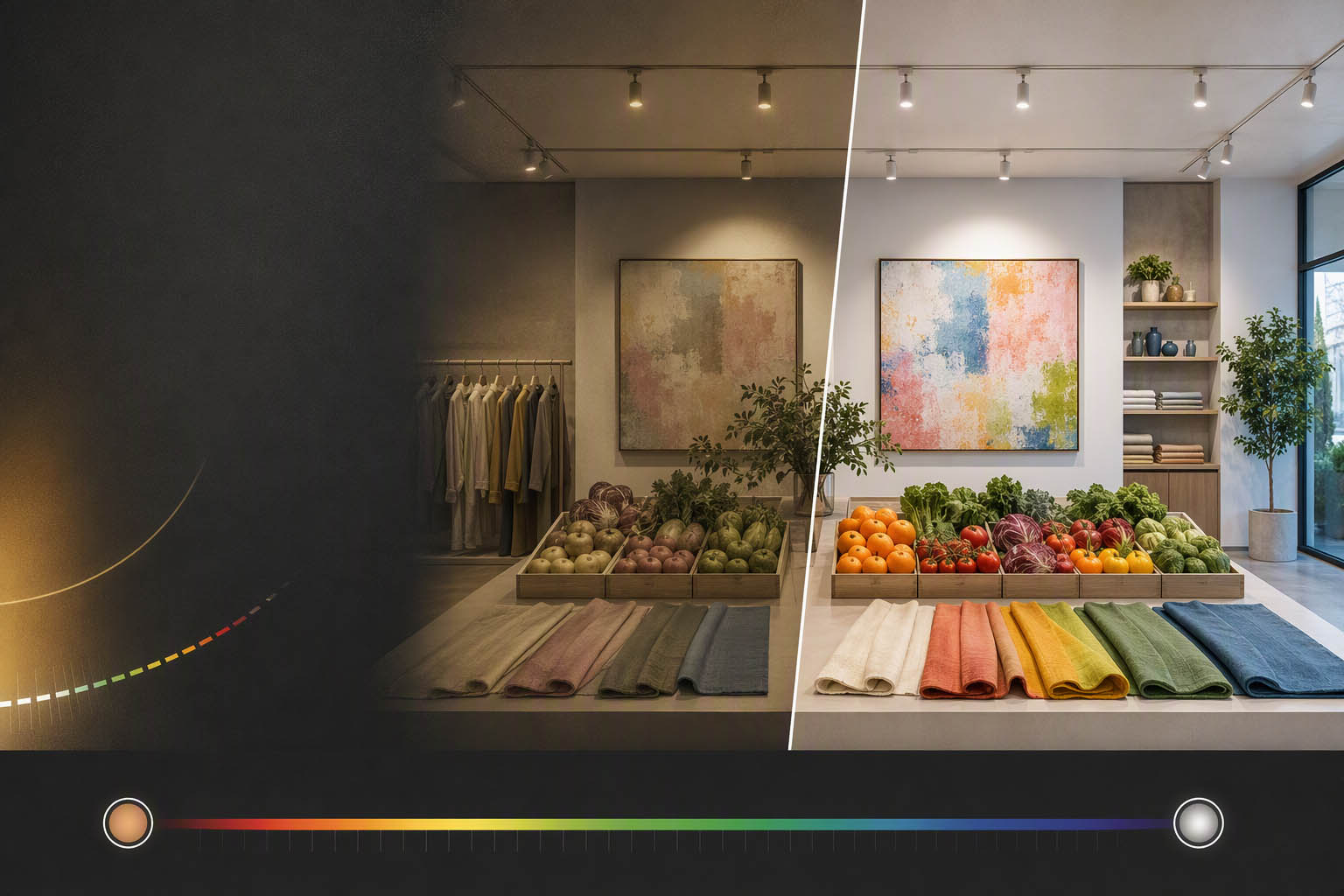
CCT does not tell you whether colors will look accurate. That is the job of color-rendering measures such as CRI, with R9 providing additional information about saturated red. For spaces where skin tones, food, merchandise, or finishes matter, review CCT and color quality together.
Figure 3. CCT changes the apparent warmth or coolness of white light; the image is a visual comparison, not a colorimeter measurement.
What other specifications should you check?
A good downlight decision goes beyond the four factors in the image. Check CRI, dimming compatibility, driver quality, glare control, wet or damp-location suitability, airtight performance, lifetime, warranty, color consistency, trim finish, cut-out size, and control-system compatibility. If the fixture will be used in a smart-home or commercial control system, confirm the actual dimmer or protocol compatibility rather than relying on the word “dimmable.”
Also compare photometric data when available. A photometric file, beam diagram, or lighting calculation can show whether the chosen lumens and spacing will provide even illumination at the working plane. In a commercial project, request complete documentation for the exact model, CCT, trim, and driver combination being specified.
How can you avoid common downlight selection mistakes?
Avoid choosing only by wattage, selecting a beam angle without considering ceiling height, covering a non-IC fitting with insulation, and assuming a cool CCT is automatically brighter or more professional. Avoid comparing products with different test conditions or confusing source lumens with delivered lumens.
The best workflow is simple: define the room’s task, estimate the required light level, select a suitable beam spread, verify installation safety, choose CCT and color quality, then confirm spacing and dimming with a plan or mock-up. This produces a more comfortable result than selecting the cheapest fixture with the highest wattage claim.
Key Takeaway
The right LED downlight balances light output, distribution, installation safety, color appearance, and control performance. Use lumens to compare brightness, beam angle to shape the distribution, an appropriate insulation-contact rating to protect the installation, and CCT to set the visual character. Then verify the complete specification against the room and local requirements.
Frequently Asked Questions
Are more lumens always better?
No. More lumens can help in a large or task-focused space, but excessive output may cause glare, visual discomfort, or over-lighting. Match lumens to room size, ceiling height, surface reflectance, spacing, and the task.
Is a 60° beam angle good for general lighting?
It can be a useful starting point for many general-lighting layouts. The final choice depends on ceiling height, fixture spacing, lumen output, and the desired uniformity.
Is a 25° beam angle suitable for a kitchen counter?
It may work well for a focused task area, but confirm the aiming, mounting position, and glare level. A slightly wider beam may provide smoother coverage across a longer counter.
Can every LED downlight touch insulation?
No. Only use a product with the correct insulation-contact approval for the installation condition and insulation type. Follow the label and installation instructions.
Does IC-4 mean the same thing in every country?
Not necessarily. Product markings and test standards vary by market. Confirm the exact certification and local code requirements instead of interpreting the label in isolation.
Does a higher CCT make a light brighter?
Not by itself. CCT changes the apparent warmth or coolness of white light. Perceived brightness can be influenced by spectrum, contrast, illuminance, and surroundings, but actual light output is specified in lumens.
What is the difference between CRI and CCT?
CCT describes the color appearance of the light source, while CRI describes how faithfully the light reveals object colors. Both should be considered when color quality matters.
Read More