
What Are You Looking For?
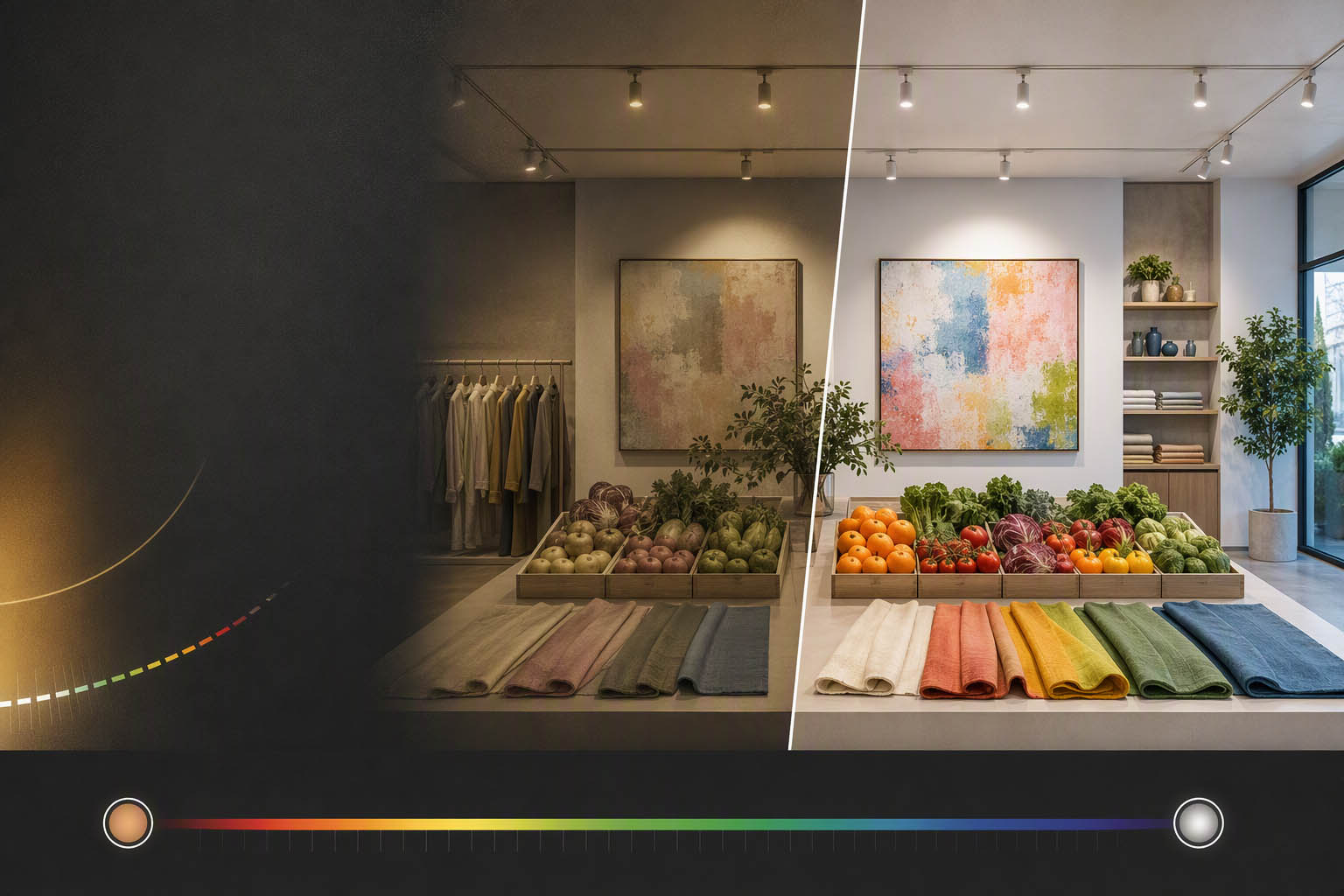
CRI, or Color Rendering Index, is a numerical measure of how faithfully a light source reveals the colors of objects compared with a reference light source of a similar color temperature. The scale generally runs from 0 to 100: a higher score usually means less color shift and more natural-looking colors.
In practical terms, CRI answers a simple question: When this light falls on a red shirt, a piece of wood, a person’s skin, or fresh food, will the colors look close to how they should look under a suitable reference source?
CRI is not the same as brightness, energy efficiency, or color temperature. It describes color fidelity—not how much light a fixture produces or whether the light looks warm or cool.
Why does CRI matter?
Color affects decisions, comfort, safety, and the perceived quality of a space. Under poor-quality light, paint samples may look misleading, food may appear less fresh, skin tones may look unnatural, and merchandise may be difficult to evaluate accurately. In a home, high color fidelity can make finishes and artwork look more natural. In retail, hospitality, healthcare, studios, and galleries, it can directly influence how people see products, faces, materials, and details.
The U.S. Department of Energy recommends a minimum CRI of 80 for interior lighting and describes CRI 90 or higher as excellent color fidelity. These values are useful starting points, but the right target depends on the application. A warehouse and a beauty counter do not have the same color requirements.
How is CRI calculated?
The traditional CIE method compares the color shifts of a light source against a reference source using standardized test-color samples. The general score, Ra, is calculated from the first eight samples, which cover a range of moderately saturated hues. The method also defines special indices for additional samples, including saturated red, yellow, green, blue, skin tone, and foliage colors.
Because the score is an average, two lamps can have the same CRI while rendering individual colors differently. This is why a single CRI number should not be treated as a complete description of light quality.
R9 is a special color-rendering value associated with strong red. Standard CRI’s general Ra score does not include the saturated red sample, even though red is important in skin tones, meat and produce, artwork, textiles, photography, and video.
A product advertised as “CRI 90” may still have a weak R9 value. When red accuracy matters, review both the general CRI and the reported R9 value. ENERGY STAR’s downlight criteria, for example, specify Ra ≥ 80 and R9 > 0 for the relevant products. Project specifications may call for a substantially higher R9 depending on the visual task.
CRI vs. CCT: what should you compare?
CCT, or Correlated Color Temperature, describes the apparent warmth or coolness of white light. Lower CCT values, such as 2700K–3000K, generally look warmer or more yellow. Higher values, such as 4000K and above, generally look cooler or bluer.
CCT and CRI measure different properties:
|
Metric |
What it describes |
Typical question |
|
CCT |
The apparent color of the light itself |
“Does the light look warm or cool?” |
|
CRI / Ra |
Average color fidelity |
“Do objects look natural under the light?” |
|
R9 |
Rendering of strong red |
“Will reds, skin, and food appear convincing?” |
|
TM-30 Rf/Rg |
A broader description of color fidelity and color gamut |
“How accurately and vividly does the source render a wider set of colors?” |
A warm light can have high CRI, and a cool light can have high CRI. Neither metric replaces the other.
Is CRI still enough for modern LED lighting?
CRI remains familiar and useful, but it has limitations. The U.S. Department of Energy notes that CRI is especially poor at predicting the fidelity of saturated reds. It also points to IES TM-30, which uses the Fidelity Index (Rf) and Gamut Index (Rg) to provide a more comprehensive evaluation of color rendering.
For a serious lighting specification, ask for more than “high CRI.” Review the test conditions, CCT, Ra, R9, TM-30 data when available, color consistency, dimming behavior, and the visual needs of the space. A sample installation or mock-up is often the best way to confirm that the light works with the actual finishes and products.
Use the application as the starting point:
The bottom line
CRI matters because light does not merely illuminate objects—it changes how their colors are perceived. A higher CRI can support more natural, trustworthy, and visually comfortable spaces, but CRI should be read alongside R9, CCT, TM-30, and real-world application testing. The best lighting choice is not simply the lamp with the biggest number; it is the source whose color performance matches the task.
Is CRI 80 good enough?
CRI 80 is a practical baseline for many general interior applications. Higher CRI may be preferable where color accuracy strongly affects product evaluation, appearance, or visual comfort.
Is CRI 90 better than CRI 80?
Usually, yes: a higher Ra score generally indicates less average color shift. However, compare R9 and other color-quality data too, because the average score does not reveal every color-specific weakness.
Does high CRI make a light brighter?
No. CRI measures color fidelity. Brightness depends on light output, illuminance, optics, and other photometric factors.
Is CRI the same as color temperature?
No. CCT describes whether white light appears warm or cool; CRI describes how faithfully illuminated objects retain their colors.
Why is R9 important?
R9 addresses strong red, which is significant for skin tones, food, textiles, artwork, photography, and video. It can reveal a weakness that the general CRI score hides.
What is TM-30?
TM-30 is a broader color-rendition method. Its Rf and Rg values provide additional information about color fidelity and gamut across a wider set of color samples.
Can two lights with the same CRI look different?
Yes. The same average CRI can result from different spectral distributions. Compare R9, TM-30, CCT, color consistency, and a sample installation when the application is sensitive to color.
leave a message
Scan To Wechat :

Scan To WhatsApp :

Home
Products
contact